Fanged frogs and giant rats found in remote
Papua New Guinea wilderness.
Papua New Guinea wilderness.
A host of strange and wonderful new species have been discovered in some of the world's most remote rainforest.
_______________________________________________
Resumen en castellano.
Un equipo de biólogos y documentalistas de la BBC han descubierto arañas de aspecto bizarro, ratas del tamaño de un gato y ranas con colmillos habitando en un enorme y prístino volcán en las alturas de Papúa Nueva Guinea.
Las especies fueron encontradas en el cráter del monte Bosavi. Entre estas, una rata herbívora de 3 pies de largo y más de 3 libras de peso.
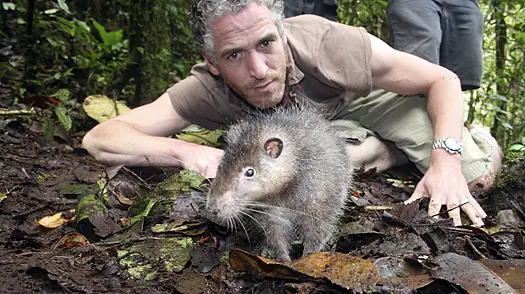
Wildlife cameraman Gordon Buchanan with the Bosavi Woolly Rat.
Los científicos sospechan haber encontrado más de 40 nuevas especies, incluyendo: 16 nuevos tipos de ranas, una nueva especie de gecko, tres nuevos ejemplares de peces, 20 tipos de insectos y arañas y una nueva clase de murciélago.
De todas estas, se destacan un gecko con la capacidad de camuflarse, una rana con colmillos y un pez que emite sonidos similares a los de un ronquido.
En uno de los viajes fuera del cráter, encontraron una oruga gigante con cientos de larvas a su alrededor.
Con la ayuda de guías locales, el equipo pasó dos semanas documentando sus descubrimientos. El viaje fue planeado con varios mese de anticipación por la dificultad que implica el descenso a dicho cráter.
_______________________________________________
A crew of scientists, academics and filmmakers from the BBC visited the South Pacific island of Papua New Guinea this past spring to film a nature documentary and in the process discovered more than 30 new species of animals. Among the unknown creatures — all living inside the crater of the extinct volcano Mount Bosavi — was a giant rat that measured 32.2 in. and weighed more than 3.3 lb., making it one of the largest rodents on Earth (scientists provisionally named the housecat-size animal the Bosavi woolly rat). The historic find also included 16 new species of frogs, at least three new types of fish and one bat. "It was mind-blowing," George McGavin, a biologist with the BBC team, told England's Guardian newspaper. "The crater of Mount Bosavi really is the lost world."
While the sheer number and size of the found animals were extraordinary — and made possible because the volcanic crater's ecology had been virtually undisturbed by humans — the scientific discovery of new species is actually quite routine. In fact, biologists are identifying new species at a torrid rate, about 50 a day; nearly 17,000 new plants and animals were described in 2006 alone, or some 1% of the 1.8 million species that have been recognized so far.
The truth is that scientists have only the foggiest idea of how many animals and plants exist on the planet. Estimates of the total number of species range wildly, from 5 million to 30 million to as many as 100 million. Although multitudes of uncharted animals and plants may be hiding in the tropical rain forest or at the bottom of the ocean, many new species are discovered today in the lab, where scientists examine the DNA of what appears to be a single, widely distributed species only to find that it's actually a collection of separate species that look alike. The dusky salamander of the Appalachian and Adirondack mountains, for example, is now known to be four distinct species.
Fuente 1
Fuente 2
Fuente 2